
Phytokana plant to bring new jobs, market for local crops
By Melissa Crispin-Piche Local Journalism Initiative Reporter
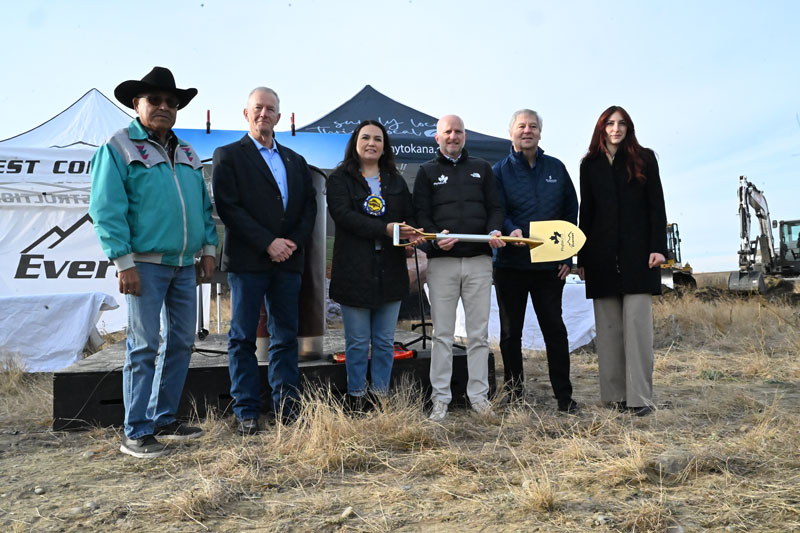
Melissa Crispin-Piche Photo
A new plant protein processing facility in Strathmore is expected to create 27 permanent jobs and give local farmers another market for their faba bean crops.
Phytokana Ingredients Inc.’s $45-million dry fractionation facility, marked by a Nov. 13 ground breaking at 84 Orchard Way, will turn locally grown faba beans into protein concentrate and flour for food and beverage manufacturers.
Mayor Pat Fule said the project will bring benefits to Strathmore and farmers throughout the surrounding region, creating construction jobs, permanent employment and, once the plant is operating and applicable incentives have run their course, property tax revenue for the town.
For growers, he said, the facility offers another crop option backed by a dependable buyer.
“They can grow this crop and they’ve got a consistent and a constant purchaser that will use their faba beans for their protein product,” said Fule. “So, it’s pretty exciting.”
President and CEO Chris Theal said access to crops was a major factor in choosing Strathmore. The surrounding mix of irrigated and dryland farms gives the company an opportunity to source the beans it needs within about a two-hour drive.
The company considered five southern Alberta municipalities before selecting Strathmore, he said. Competitive incentives and support from the town, mayor and council also helped bring the project to the community.
Fule said council’s enthusiasm began when Theal first presented the proposal in October 2021.
“He knew his product (and) he knew what needed to be done,” he said.
The mayor credited the town’s administration and planning department for helping move the project forward. He also thanked the Western Irrigation District for its work with the town to make the land available for purchase.
Fule hopes the investment will encourage other agricultural technology companies to consider Strathmore, with Phytokana’s experience helping demonstrate what the community can offer.
“We hope that it’ll be a catalyst,” he said.
Speaking ahead of the groundbreaking, Theal said site preparation was already underway, with excavation for foundations expected to follow the next week.
“Basically, once we get going, it’s about a 14-month construction cycle and then we start commissioning the facility,” said Theal.
The company expects to begin producing ingredients that meet commercial specifications in late 2027 or early 2028.
Theal estimated construction would involve about 54 jobs over the course of the project. Once operating, the plant is expected to employ 27 people across three shifts.
Most major construction contracts have been filled, although additional support services will be tendered as work progresses, he said.
For farmers, the plant will create demand for an initial 30,000 metric tonnes of faba beans annually. Its layout has been designed to accommodate a second phase that would double capacity to 60,000 tonnes. Theal said the company anticipates that expansion in 2030.
Phytokana plans to offer production contracts for the 2027 growing season and pay a premium for beans that meet its requirements.
Inside the facility, beans will be inspected, cleaned and stripped of their outer hulls before being sorted to remove damaged or unsuitable beans. A microbial reduction step will prepare them for food use.
The beans will then be milled into fine flour and separated using air currents. Larger, heavier starch particles separate from smaller, lighter protein particles, producing a concentrate containing about 70 per cent protein, along with a starch-rich flour that retains some protein.
Theal said the dry separation process uses no chemicals, heat or water.
“So, it’s a clean label ingredient at the end of the day, and it has a very, you know, low environmental footprint,” said Theal.
Fule said the ability to turn locally grown crops into protein ingredients for use elsewhere in the world is another appealing part of the project. He pointed to the potential for those ingredients to increase the protein content of foods and help meet nutritional needs.
Automation is another significant part of the investment. Theal said the company is spending about $3 million on additional automation and machine learning to improve reliability, energy efficiency and product consistency.
The system will adjust equipment to account for changing conditions, including temperature, humidity and moisture in the beans. The goal is to produce consistent ingredients from one batch to the next, something Theal said food manufacturers identified as a priority.
The company is developing international markets for those ingredients, with particular attention to the Asia-Pacific region.
“Our customers are looking for protein and fibre solutions for the spectrum of food or beverages that they’re making,” said Theal.
He said the company’s sales agreements extend beyond Canada, connecting crops grown near Strathmore with food and beverage manufacturers abroad.
Fule also expressed appreciation for the participation of Siksika Nation representatives Coun. Jamie Spring Chief and Elder Clarence Wolfleg in the groundbreaking, including the smudge and blessings offered at the construction site. He said the project’s potential extends beyond town boundaries, benefiting neighbouring agricultural communities as well.
For nearby residents, Theal expects limited disruption from construction and the plant’s eventual operation. The company has completed a transportation assessment, and major earthmoving equipment was already on site ahead of the ceremony.
As construction moves forward, Theal said the company’s focus is on establishing dependable production for its customers.
“That’s really the commitment that we’re making with this plant is to be a stable, reliable supplier,” said Theal.
Phytokana also scheduled a public information session for Nov. 17 at the Travelodge in Strathmore, with a presentation on the company and information about production contracts for the 2027 growing season.