
Farmers pause harvest to support hospice
By Melissa Crispin-Piche Local Journalism Initiative Reporter
Melissa Crispin-Piche Photo
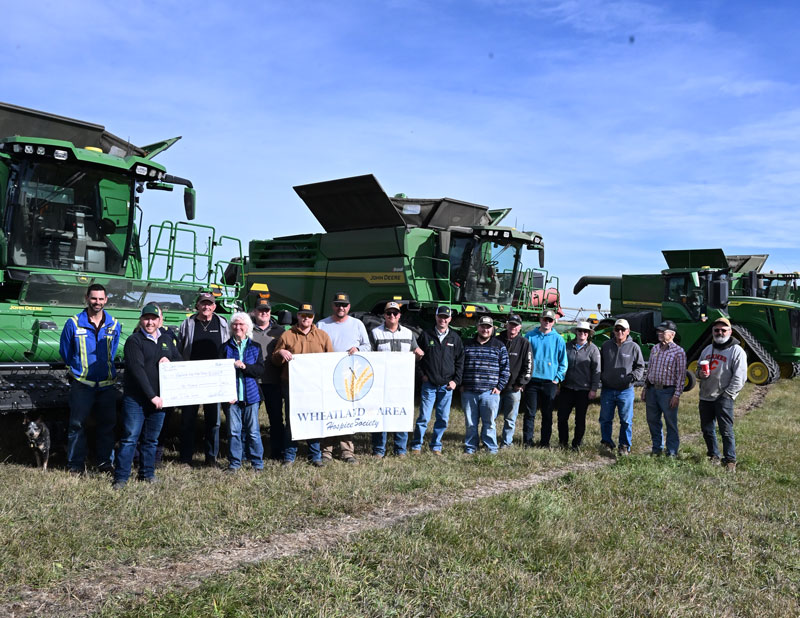
With their own harvests still demanding attention, local farmers set aside time Oct. 16 to help bring hospice care closer to home.
The Farming for Hospice kickoff brought volunteers and representatives from John Deere and Nutrien together in support of the Wheatland and Area Hospice Society.
For Keith Clayton, the society’s first president and a long-time organizer of the fundraiser, the effort reflects a community willing to work toward a shared goal.
“Everybody’s interested in the end result, which is getting a hospice built,” he said.
Clayton has been involved with the society since its inception. He said he was initially approached to help lead the effort to establish a hospice in Strathmore and has remained involved ever since.
The farming fundraiser grew from a familiar rural approach: grow a crop together and use the proceeds to help others. Dr. Joni McNeely, chair of the Wheatland and Area Hospice Society, said the initiative was modelled after the Foodgrains Bank approach.
The first Farming for Hospice crop was grown near Standard in 2019. Clayton subsequently helped establish a partnership with Nutrien, which provided access to farmland near its Carseland plant. He said that partnership is now in its seventh year.
Using the land allows the project to grow a fundraising crop without asking a local farm family to give up a quarter section that contributes to its livelihood.
Farmers and agricultural businesses contribute throughout the growing season providing labour, equipment and services to prepare the land, manage weeds and bring in the crop.
Clayton said he helped with harrowing, swathing and combining this year. Other volunteers and businesses have contributed spraying and tillage work.
But he stressed that the fundraiser involves much more than selling grain.
Community members sponsor acres of crop inputs for $300 each, with partial-acre donations also welcome. Those contributions help cover growing costs, allowing proceeds from the crop to support the society’s work.
Clayton said acre sponsorships account for the majority of the project’s overall fundraising, and people can continue contributing through Christmas.
“It’s a yearly project,” he said.
Support also extends beyond Wheatland County, with farmers from Rocky View County among those involved.
For McNeely, that willingness to help neighbours is at the heart of the society’s work.
“We’re all in this together,” she said.
The support comes as the society continues working toward a residential hospice while providing services to patients and families who need help now.
“At the heart of what we do is a very simple goal. It’s to ensure that people in Wheatland County have access to compassionate, high quality, hospice palliative care,” McNeely said.
The society serves Strathmore, Wheatland County and surrounding communities. Its outreach work includes palliative navigation, caregiver respite, companionship, bereavement support and community education.
McNeely said keeping people near those they love matters throughout end-of-life care.
“It’s so important to stay close to home, where you’ve got the support of your family, and your neighbours, and your friends,” she said.
The society remains committed to a residential hospice at Kinsmen Park, planned alongside a senior’s lodge operated by the Wheatland Housing Management Body.
The two organizations would remain independent, with separate operations and entrances, while sharing some building infrastructure and costs.
“We’ve been partners with the Wheatland Housing Management Body for a number of years,” McNeely said.
Securing funding remains a hurdle. The hospice needs sustainable funding to staff and operate its beds, while the housing management body needs capital funding for its portion of the shared building.
McNeely said the broader goal remains access to care.
“We do welcome any hospice care and any hospice space in Wheatland County,” she said.
While work toward a residential hospice continues, the society is exploring a Wheatland Palliative Hub in Strathmore, which it hopes to develop in 2027.
The timing and location have not been finalized.
McNeely described it as a “hospice without walls” that would connect patients, families, caregivers, volunteers and local care providers. The proposed hub could offer help navigating services, access to equipment, caregiver support, grief support and education. A dedicated space could also provide activities and opportunities for patients and caregivers to connect.
If it goes ahead, the hub will support people wherever they receive care and help prepare for a future residential hospice.
“We remain committed to that vision and we’re recognizing that there’s important steps ahead for us,” McNeely said of the residential project.
In the meantime, the society continues developing its bedside respite, No One Dies Alone and navigator programs, along with partnerships supporting equipment and other local care needs.
Community members can help by volunteering, donating and speaking with elected officials about the proposed Kinsmen Park project.
“Both residential hospice and a low-income senior’s lodge are so important for our community, and I think it’s a priority,” McNeely said.
Farming for Hospice is also looking ahead to a Nov. 27 wrap-up featuring Drew Gregory and three fellow performers in a songwriter circle, with a meal served. Further details are expected as arrangements are finalized.
Clayton said the gathering provides an opportunity to bring supporters together and thank those who have contributed. Plans are also underway to grow another crop next year.
Information about the society’s services, acre sponsorships and ways to get involved is available online (wheatlandhospice.ca).