
Christ the Redeemer to offer post-secondary dual credit options
By John Watson Local Journalism Initiative Reporter
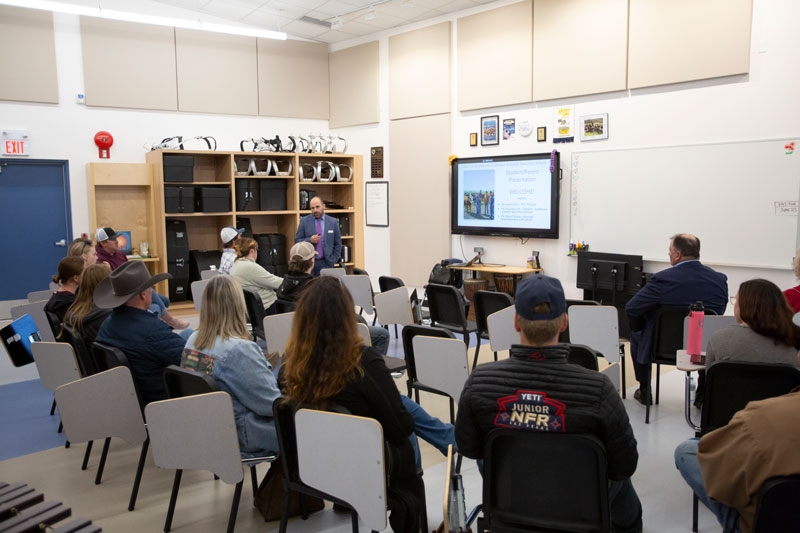
John Watson Photo
Christ the Redeemer Catholic Schools will begin providing students with opportunities to get head starts on their post-secondary educations as of this fall.
The program to be offered has been developed as a partnership between Christ the Redeemer Catholic Schools, the Strathmore and District Agricultural Society, and Lakeland College.
“We see ranching as a viable career option for students in our region. We are proud to offer a program that gives students hands-on experience while helping support the future of agriculture in our community,” said Marco Pacione, associate superintendent for Christ the Redeemer Schools. “We are very happy with the turnout at our first information evening, (June 17), for students and parents. We know that in talking with our students and the conversations we had with families, we sense that there is excitement about the flexible scheduling that will be available.”
Approval for the implementation of the program only recently was handed down from Alberta Education.
Pacione explained between the school division and staff from the ag society, a significant amount of lobbying for the program has taken place with the province in order to advocate for its approval.
“The program involves flexible scheduling here at Holy Cross Collegiate … they are still a Holy Cross Collegiate student, (but) they have a program being added to the school that students can access, almost like another track,” he said.
The idea being to allow high school students to simultaneously earn credits towards their diplomas, as well as for their post-secondary educations.
Schedule dependent, students will generally have their normal classes at the school in the morning and will be off campus in the afternoons.
“It is like a lab when you get to do some of the hands-on learning with the agriculture related pieces, and those experiences in the afternoons (will be) with the support of the Ag Society, some on their existing grounds, and some on nearby farms and ranches,” said Pacione. “We are working on transferability … we are feeling optimistic about that and we are working with Lakeland College right now; they are doing some leg work to provide for us clarity on which other schools in Alberta these courses will also give students advanced credit in agriculture.”
As it is currently set to be structured, any participating student between Grades 10-12 will commit to the program for one year, taking courses in animal handling, beef production, diseases and treatment, and range and forage.
“This year, we are working and we have had a couple meetings now, and we have a couple more planned weekly to try to figure out and get a lot of the details in place for a lot of these things that are going to be moving forward,” said Doug Raycroft, CEO of the Ag Society. “One of the things that started this was our plan to build a western events center and the plan to use that facility for a lot of the things that could be considered agricultural or for practical ranching. To start, we have a lot of facilities that we can use as well.”
CTR students are being encouraged to apply for the program through contacting their principal, Lavern Evans, as of the start of the 2026-27 school year.