
Chamber brings businesses and local leaders together at first State of the Region
By Melissa Crispin-Piche Local Journalism Initiative Reporter
Melissa Crispin-Piche Photo
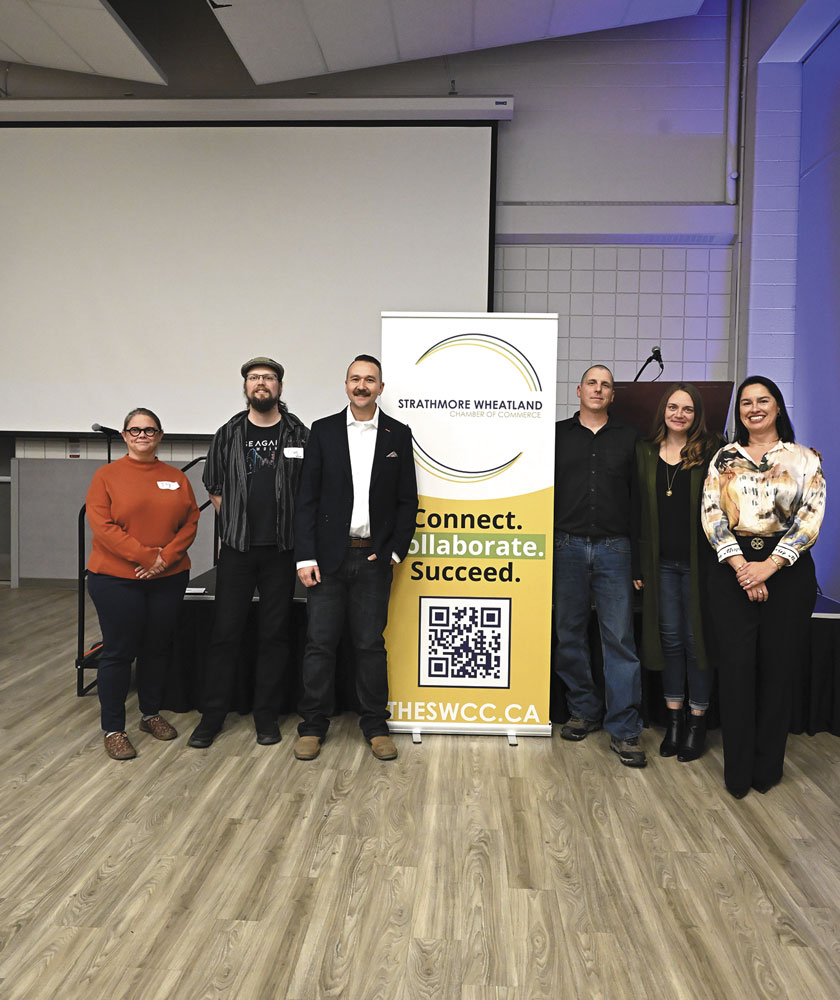
Business growth, regional investment and the challenges facing local employers brought business owners and elected officials together Oct. 8 for the Strathmore and Wheatland Chamber of Commerce’s first State of the Region event.
The room was filled with business owners and chamber members, alongside community representatives and local leaders. Strathmore Mayor Pat Fule and town council members attended, as did Wheatland County Reeve Scott Klassen and county council members. MLA Chantelle de Jonge also addressed the gathering.
A business survey helped set the stage for the event. In an interview beforehand, chamber chair Coby Royal said the idea grew out of a business walk that asked owners what was working, where they needed help and how the community could better support them.
“We really wanted to bring people together,” Royal said.
The resulting report put those responses on paper, giving the chamber a starting point for conversations about what businesses need to succeed.
Throughout the evening, speakers connected that local feedback with a broader discussion about investment, municipal planning and the resources available to employers.
The speakers began with a recorded message from MP David Bexte who unfortunately couldn’t attend in person due to being in Parliament. His message was clear as he strongly supports events like this, having businesses and local governments gather to promote and help Alberta’s economy thrive.
de Jonge highlighted major projects in the region, including De Havilland’s aerospace development and CGC’s wallboard plant in Wheatland County. She also pointed to a planned $225-million investment in a new facility in Strathmore.
Those developments offered reasons for optimism, she said, while uncertainty surrounding Canada-U.S. trade continued to put pressure on businesses.
“Tariffs and counter tariffs, they raise costs, they disrupt supply chains, and they make it harder for businesses to plan ahead,” she said.
de Jonge encouraged businesses to use Alberta’s tariff feedback portal to explain how those pressures were affecting their operations. She also discussed Level Up, an export resource intended to help Alberta companies reach customers elsewhere in Canada and internationally.
“So, if tariffs are impacting your businesses, please tell us we want to know,” she said.
Growth and community priorities
Mayor Pat Fule said six of Strathmore’s seven council members were present, reflecting the importance council placed on the event and the chamber’s work.
His presentation outlined six priorities in the town’s strategic plan: community connection, managing growth, financial resilience, economic growth, protecting water and green spaces, and community safety and well-being.
Fule discussed housing, infrastructure renewal, water capacity and efforts to attract physicians. He also emphasized stronger working relationships with Wheatland County and Siksika Nation, describing opportunities for regional collaboration.
Supporting local businesses was part of that approach. Fule said council now holds its retreats in town and uses local restaurants, keeping that spending in the community.
Strathmore chief administrative officer Kevin Scoble followed with a presentation on municipal finances, taxation, growth and infrastructure.
Scoble said the town had made progress increasing reserves and reducing debt, while significant investment decisions remained ahead. He discussed planning for a new fire hall and the continuing costs of replacing infrastructure, improving accessibility and preparing for changing weather conditions.
He also explained the town’s goal of moving toward a tax revenue split of 70 per cent residential and 30 per cent non-residential through business expansion and attraction.
Wheatland County’s manager of financial services Joel Chiasson described an economy rooted in agriculture and energy, with opportunities in manufacturing, highway commercial development, arts and tourism.
He outlined the different roles of the county’s industrial areas, the Highway 1 corridor and Rosebud, while emphasizing agriculture’s continuing importance.
Chiasson also highlighted how different parts of Wheatland County contribute to the regional economy. Goldfinch Industrial Park supports manufacturing and heavy industry, while the Highway 1 corridor connects businesses with Calgary and markets farther east.
In Rosebud, the theatre and school of the arts help draw visitors and support tourism. Together, those areas offer opportunities to diversify the county’s economy while maintaining the agricultural roots that continue to shape its growth.
He also emphasized agriculture and energy as the foundations of Wheatland County’s economy.
He pointed to growth in farming, livestock and cropland, while highlighting the role of Hutterite colonies and agricultural education in supporting the sector’s future. The opening of an agriculture-focused school southwest of Strathmore reflected that commitment to the next generation.
Oil and gas also remain important to the county’s economic sustainability, he said, with new technology creating opportunities to build on those established industries while encouraging responsible development and investment.
“Agriculture is the backbone of this camp,” he concluded.
Wild Rose offers helping hand
Lindsay Desroisier, business development officer with Community Futures Wild Rose, presented findings from the May business walks conducted with the Town of Strathmore, Prospect Human Services and the Chamber of Commerce.
The survey drew responses from 156 businesses, representing a 56 per cent participation rate among the town’s 277 licensed businesses.
While many reported doing well, rising costs remained the leading challenge, with owners facing higher expenses for rent, utilities, supplies, insurance and wages.
Desroisier highlighted business coaching and financial tools available through Community Futures to help owners understand their costs, set prices and “we want to help you protect your margins.”
Building a stronger chamber
Royal closed the evening with an update on the chamber’s direction, describing its purpose as protecting, supporting and promoting local business and the regional economy.
That work includes advocacy, networking and connecting businesses with resources.
She said the volunteer board had adjusted its strategic plan to focus on realistic goals, including updated bylaws, clearer policies and procedures, improved membership records and simpler administrative systems.
“Our membership has been slowly growing, which I’m very excited about,” said Royal.
The chamber is also working to make membership benefits more visible. Royal said a members’ gathering was being considered for around Nov. 23, with the Alberta Chamber of Commerce invited to explain the resources available.
She encouraged members to consider how they could support one another, whether through social media, professional advice or services.
The chamber’s plans include six events over the coming year. Among them are the annual cookie walk, business excellence awards in January 2027, a job fair with Prospect Human Services and an AGM in May 2027.
After the presentations, organizers replaced the planned panel discussion with an opportunity for attendees to approach speakers directly, ask questions and connect over refreshments.
More information on what the chamber has to offer, Prospect Human Services and also Community Futures Wild Rose can be found on their websites.