
Strathmore resident celebrates 100 blood donations
By John Watson Local Journalism Initiative Reporter
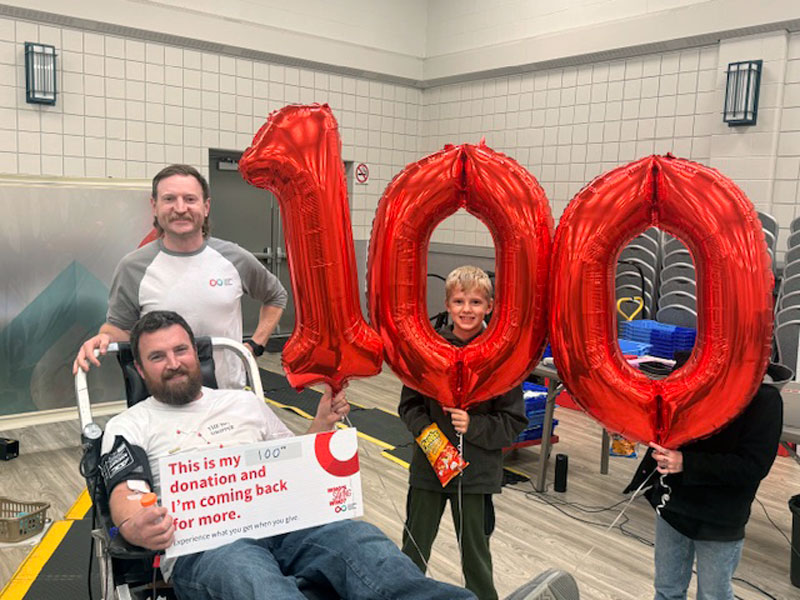
Photo Courtesy of Daniel Cammaert
Strathmore’s Andy Cammaert celebrated his 100th blood donation, Oct. 16, after 24 years of donations.
Throughout the near quarter-century of donations, his contributions have been entirely whole blood, as opposed to plasma or platelets, which can be donated more frequently.
“Most donors who do it donate plasma, which is more of a weekly. Andy has been doing this for 24 years now, and he started when he was attending university,” said Daniel Cammaert, Andy’s brother. “Maybe he just (does it) because of the free juice and cookies; being the guy he was, he thought he would go donate and figured out he was a universal donor, and that’s highly sought after and kind of critical for our emergency services.”
For male donors, the maximum whole blood donation frequency is every eight weeks, meaning six donations can be made per year. For women, it is every 12 weeks, meaning only four times per year.
Cammaert added his brother began encouraging family and friends to also get in on donating blood whenever they could throughout the early 2000’s. Eventually, a small community formed around the occasion.
“If I can speak for Andy, it’s the community and the social aspect that he values. I don’t think we have had any personal tragedy or something like that really inspires us to donate but it was just good for getting together and giving back,” said Cammaert.
“Canadian Blood Services has a website, and I think they say it’s up to three lives that can be saved per donation. Without knowing the number, I think it’s up to 300 (for Andy).”
Cammaert and company eventually came to call their group, “Bleed and Feed” after their acquired tradition of getting together to donate blood, then sharing a meal.
The group typically sees between six and 12 people going at a time once the donation period refreshes for each person.
As of 2023, Canadian Blood Services is credited with releasing that less than two per cent of eligible Canadians donate blood or plasma.
A variety of factors influence eligibility to donate blood. To become a donor in Canada, you must be at least 17 years old.
Other factors include not being impaired by drugs or alcohol at the time of donation, having sufficient hemoglobin and iron to prevent anemia post donation, underlying medical conditions, and temporary ineligibility due to recent vaccination.
Factors to consider also include needing to wait three months after receiving a piercing or tattoo, during and six months following pregnancy, three months following anal sexual activity, recent travel history, and prior exposure to certain animals.
General awareness, as well as a ‘someone else will do it’ attitude is attributed to the lack of participation.
A total of 35 permanent donation centers, and over 4,000 mobile centers are maintained across Canada.
More information about blood donation can be found online (www.blood.ca).