
Strathmore Times and Strathmore Royal Canadian Legion Branch 10 host all-candidate forum
By John Watson Local Journalism Initiative Reporter
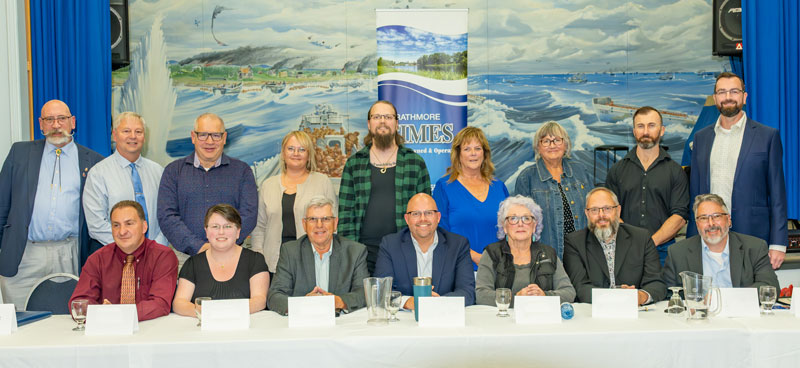
Joe Lepage Photo
An all-candidate forum was held at the Strathmore Legion, hosted by the Strathmore Times and the Strathmore Royal Canadian Legion Branch 10, Oct. 6, for the aspiring members of Strathmore’s next town council.
Each of the 14 candidates running for council and the two candidates running for mayor, Jason Hollingsworth and Pat Fule, were in attendance for the forum, which filled the legion hall.
The format presented three predetermined questions, to be answered in turn, with strict time limits given to each in order to ensure smooth and timely proceedings.
Due to space and time limitations of publication, the first question asked of candidates is summarized in this article.
The question posed to candidates asked how they, as council members, would work to strengthen relationships with Strathmore’s regional partners to ensure Strathmore not only benefits from its growth, but also contributes to a strong shared future where all communities in the region can thrive together.
Brent Wiley, referencing time spent door knocking and speaking to members of the community throughout the summer, described that among the challenges and considerations, would be how to grow the town prudently, intelligently, and with solid planning.
“Some of the things that people have related back to me is that this town is friendly; they have gotten to know their neighbours, the streets are safe, there is a variety of housing available here, there are miles of pathways and bridges, green spaces, playgrounds and parkland,” he said.
“There are developers who already own all the land surrounding the town; they already have permission through area structure plans to build it, and so what we need to do as a council is meet with those developers as a group, one on one, and discuss with them what’s their current vision for this town, what’s our vision for this town, and find overlap so that as we grow, we can grow and continue to be the kind of town that we love.”
Dan Wiewel aimed to emphasize the importance of planning and zoning for Strathmore’s imminent growth as it approaches the size Chestermere was when it became a city.
“Strathmore isn’t ready to become a city yet – far from it, but we have to start thinking like one. We have to start planning our zoning. If we don’t use this land that we’re gonna be acquiring soon and developing properly, we may end up in the same boat as so many cities that we’ve seen that have had to do blanket rezoning across the entire area, and all of a sudden a street that was nothing but single family homes now is free rein to put up whatever a developer would like,” he said. “If we want a strong economic growth to follow with our population growth, we need places for business owners like myself to rent. I’ve spoken to more than one business that has had their rent double in the last few years. I spoke to one that they’re in the middle of negotiating their next lease, and their landlord wants triple what they’re paying right now. That is not sustainable.”
Richard Wegener, acknowledging the impending boom in and around the town, suggested leveraging the incoming corporate developments to establish ancillary facilities in town to benefit from additional tax dollars.
“As it stands with De Havilland and the CGC, all the tax money is going to the county. We want to make sure that we can leverage that to build, to bring our tax rate up. Right now, our tax rate, residential to non-residential is about 78:22, a good, healthy [ratio] would be 70:30, or even less than that,” he said. “As far as the housing market goes, Federations of Communities Municipalities says that for every house build in a subdivision, it costs the municipality $107,000, so that is going to be a huge burden on our tax rate – it is going to be a huge burden on our facilities. If we can leverage these companies to help with that, maybe help with the building of roads, help with the building of fire halls, looking at sports facilities, we can do it and grow.”
Trevor Snyder suggested that the way to tackle imminent, substantial growth is with a forward-thinking council, in order to develop appropriate area structure plans, and improve intermunicipal relationships, in this case in particular with Wheatland County.
“There are so many ways to improve these relationships ,and it all just starts with a few meetings, introduction meetings, and it can grow into amazing opportunities. And it’s one of those things where you have to take a look at where do the residents want the future of our town,” he said. “Do we want a big city? Do we want to keep things medium size or midsize? So, we need feedback from residents as well. That’s pretty much generalizing.”
Denise Peterson opted to focus on the issue of potable water and ensuring the town, in the long term, is able to sustain a significant population boom from an infrastructure and services perspective.
“I think we’ve taken water for granted and we shouldn’t … we obtain our water through the pipeline from Calgary and our sources of Bow River, which we know is running at 37 per cent and there’s significant evidence that it’s continuing to decline. We saw firsthand during the Calgary infrastructure failure in 2024 that Strathmore’s potable water is subject to the decisions made by the city, and we should be concerned about how this is going to impact our future,” she said. “There are measures that we can undertake. In our last term, I was strongly in favor of setting up a water reserve in order to purchase additional water licenses. We’ve done this and we’ll continue to do it, and I think that it’s going to be critical to our future success. We need to urge the Alberta government to consider different legislation for water usage in our land use bylaws. We need to consider how we’re going to run our wetlands and how we’re going to mitigate the water situation that’s happening in many of our communities going forward.”
Jason Montgomery chose to emphasize the importance of diplomacy and intermunicipal relations, particularly with Siksika Nation and Wheatland County in order to collaborate about the future of Strathmore.
“When we have good relations with our partners, they’re gonna be more willing to come in and collaborate with us. So, for example, the sports center in town here, that’s a three-way partnership between, the town, the county, and the school board,” he said. “What currently what happens is the county actually kicks in hundreds of thousands of dollars every year into our budget go – that goes towards things like sports amenities and stuff like that. And even just paying for the use of the roads. And that’s a result of the good relations that we have had with partners like Wheatland County.”
Debbie Mitzner explained she aims to expand the town’s local non-residential tax base, and use those developments to fuel residential expansion.
“As a council, we need to create more industrial spaces, retail and commercial spaces. This will increase our tax base and take a lot of the pressure off the residents as we’ll help generate more income for the town. So that’s my goal, is to create more spaces for people to work at home, live at home, more tax dollars from the commercial source and the industrial source versus it all in the residents,” she said. “We are going to grow and there is going to be a lot of growing pains, but we need to stay together as a community. We need to work together as a community. We need to maintain our neighbours. Growth can affect our neighbours; growth can affect our friends.”
Melissa Langmaid stressed the importance of the land use bylaw and the municipal development plan as Strathmore begins its period of rapid development and expansion, with the aim to maintain a community that works for everybody.
”That work will be incredibly vital, and I hope to see all of the faces that are here today in the meetings that we have when we’re consulting on the work that we need to do for those plans, because those are the plans that are going to outline the future of our community,” she said. “Those are the plans that are going to determine what Strathmore will look like a decade from now, or two decades from now.”
Matt Hyde suggested he believes the key to a successful Strathmore will be with establishing better relations with municipal partners.
“The key is relationship. That’s where it starts because if you don’t make the effort to make sure that your partners around you recognize that you’re open for business, then you don’t have a place to start the conversation,” he said. “One of the challenges that I’ve identified in Strathmore … is that there is an imbalance between residential, commercial and lack of industry. I see us needing to bring more industry into the Town of Strathmore so that more people can work where they live. Also, with industry comes higher paying jobs, brings a broader tax bracket so that we can take some of that tax burden away from the residents.”
Jason Hollingsworth said that with the advent of an imminent economic boom in Strathmore, comes the opportunity to examine how not to approach the situation, referencing the City of Chestermere as a prime example.
“I would like to see light industry brought here. Perhaps some partnership with companies like De Havilland. As far as I’m aware, they only make approximately 25 per cent of the components that go into their airplanes. Why can’t we bring some of that manufacturing here so people can live and work here? And if you’re living here and working here, you’re spending money here and that’s going to support other businesses that are in town as well,” he said. “As we grow, we also need to make sure that we have (the) appropriate amount of infrastructure. It’s things like recreational complexes, underground infrastructure, other businesses like that. I would like to see us partnering with some of these large businesses that we can hopefully bring in and we can build some of these facilities so that it is not on the back of the taxpayer.”
Robert Gray suggested Strathmore missed the prime opportunity to plan for a boom such as the one currently impending and must immediately begin work on developing its relationships and strategies for the future in order to avoid disaster.
“(We need to) provide the right economic environment for growth. The other thing that we need to be concerned about is … our infrastructure. There’s no sense planning for growth if we don’t get the infrastructure in place to support that growth,” he said. “It’s going to take some significant leadership … as the council that leads us for the next four years. We need to make sure that our interests are being represented for the people that are here today and the people that are going to be here for tomorrow. It would be wonderful if we could build a community that people could live here, work here, and retire here.”
Denise Geremia emphasized her belief in the importance of developing services to accommodate what will be a rapid population growth in town over the next several years.
“I really hope that, you know, with all this boom, it helps us get more schools because we need more schools in this town. We need more doctors. We, with all this boom, we’re going to need so much more stuff, which means we have to have more infrastructure and all of these other things,” she said. “Basically, what we have to do is be able to also afford everything and so that our taxes don’t go crazy. I hope we can get sports and recreation places and more things to do for families, single people and seniors.”
Pat Fule said he aims to reestablish a strong working relationship with the county once the new councils are elected and further develop intermunicipal collaboration, similar to the framework laid out during the previous term.
“ I will have to admit that our relationship in this latest term with Wheatland County was very strained. But in my three previous terms, they were very solid and very strong. We have a very solid relationship with Rockyford Standard and Hussar, as well as Siksika Nation,” he said. “We have successful partnerships with Rockford, Standard, Hussar. In fact, in Rockyford, we sent our street cleaner there at a reduced price for them to use.
“I suggested to our CAO that we have a town-organized open house for commercial realtors in the Calgary area to showcase the town, showcase the various sites that are empty, see if we can find a way to get them housed.
James Chisholm suggested to buckle down with the logistics and planning side of development, in order to establish a strong plan and framework throughout the upcoming term.
“It all starts with a strong vision statement. If you have a strong vision statement, then that transitions into strategic priorities. And when you have strategic priorities, which this would fall under, you go to strategic objective,” he said. “Building strong alignments, building strong relationships with community leaders will help us in achieving our vision statement … we strongly recommend Strathmore to be a place where we can live our entire life cycle, and (you do that by) having controlled growth in residential, commercial, recreation, (and) arts; you have strong financial management that will be (good) in good times, and great in bad times.”
Claude Brown suggested his background as a data analyst, and his diverse array of careers gives him the ability to carefully analyze potential problems and shortfalls.
“I believe that collaboration with the communities and surrounding communities will provide opportunities for council to see what can and will happen to measure our growth and have it progress at a rate that is going to be sustainable and will not burden the taxpayer,” he added. “It’s really important that we don’t take the burden of everything that comes so rapidly and so quickly.”
Bev Bell brought forward a suggestion to take a more unified approach alongside Wheatland County in sharing resources to ensure the success of both municipalities through the imminent business and population surge.
“So we all talk about bringing in more business and trying to lower the tax base with more commercial business, which I think is a necessary thing to do, but I’m wondering if this is going to be the thing of the future where we have more and more people coming, businesses coming in to purchase rural land, to start their businesses up because it’s cheap … but we’re kind of the guys left holding the bag here,” she said. “They’re saying to us as a community, ‘We want you to bring in those 10,000 homes to us. Hey, we’ve got people here that need a place to live,’ and the cost was, I believe, $107,000 for each home … I think what we need is a way to get along with our neighbours, particularly the county. We need to find a way to say what’s fair for them is fair for us because we can grow together, we can share our resources, and the same with Siksika.”
To view the entire candidates’ forum, visit the Strathmore Royal Canadian Legion Branch 10’s YouTube page.
Election day will take place on Oct. 20, with voting stations open at the Strathmore Civic Center from 10 a.m. to 8 p.m. Advance voting will be available Oct. 15 and 17 at the Civic Center with the same hours.